2026–27 Mid-Term Report
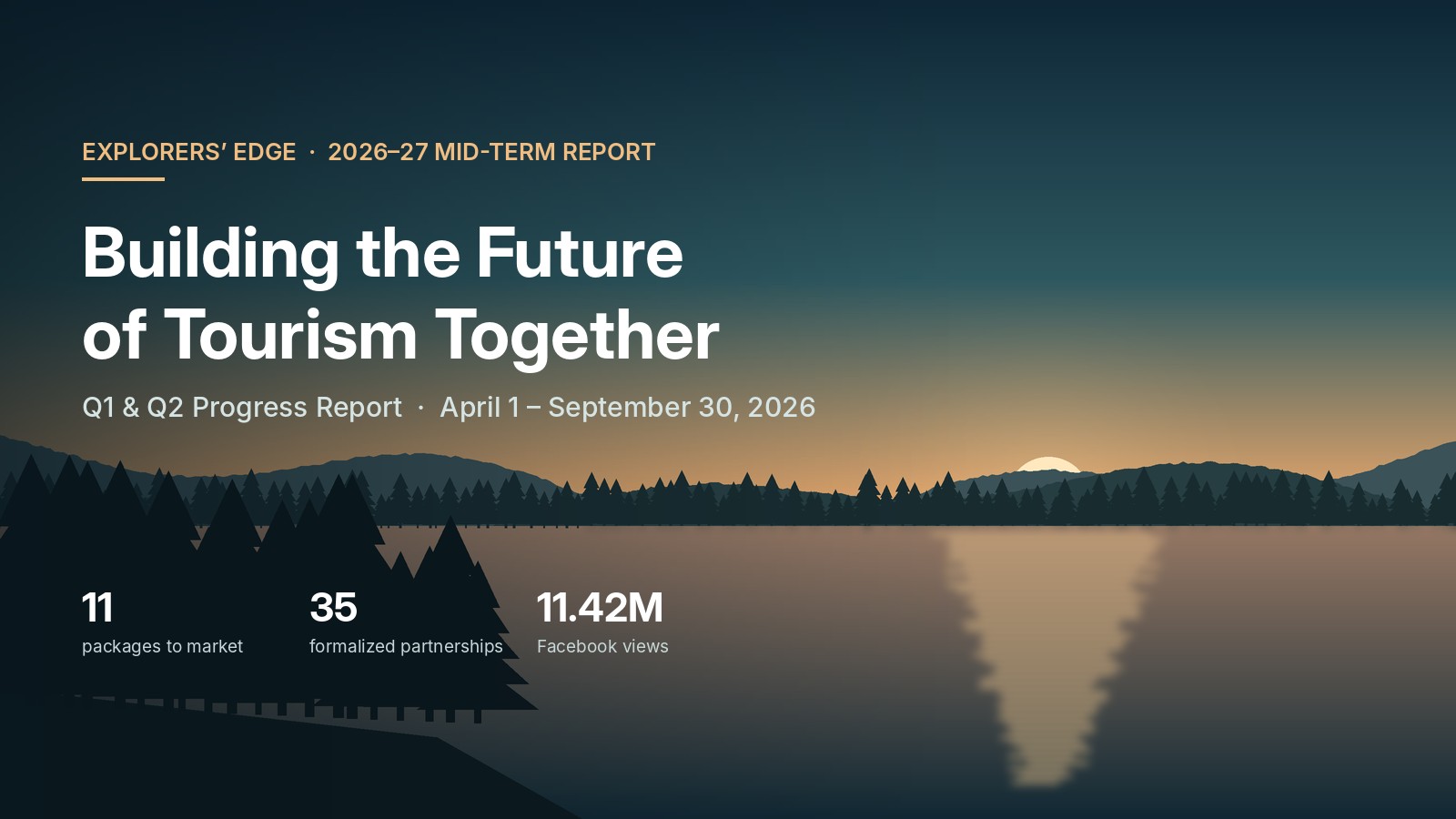
Building the Future of Tourism Together
From destination marketing to destination development: an account of the activities, investments, partnerships and results from the first six months of our fiscal year.
Tourism is more than attracting visitors
It is about strengthening local businesses, creating meaningful employment, connecting communities, improving accessibility and building an economy that delivers benefits throughout the year.
Our work continues to evolve to reflect this broader opportunity. We are moving toward an integrated approach to regional destination development, one that connects tourism product development, transportation, investment attraction, workforce development, visitor intelligence and commercial opportunities.
Our first six months
These numbers reflect growing connections between regional tourism investment, industry participation, consumer engagement and measurable economic opportunity. Many initiatives remain in development, with additional outcomes anticipated in the second half of the fiscal year.
Our five strategic pillars
Each pillar has distinct objectives and performance measures. Their combined value comes from connecting the work across the region.
Turning regional experiences into bookable tourism products
We are increasingly working with operators to create experiences that can be packaged, marketed and purchased. Central to this is the Great Canadian Wilderness Regenerative Travel Agency, which connects accommodations, attractions, restaurants, outdoor experiences, cultural tourism and transportation into market-ready itineraries.
Still early in its commercial development, the agency is showing us what travellers will buy, how far ahead they book and which experiences can best support shoulder-season visitation. Other priorities include culinary and agritourism, premium travel, outdoor recreation, cultural and heritage experiences, Indigenous-led tourism, Women in Tourism and inclusive tourism.
The Indigenous Youth Tourism Entrepreneurship initiative, the Wiigwaasi Jiimaanke Birchbark Canoe Build and ongoing relationships with First Nations show the importance of community-led tourism grounded in cultural understanding and economic reconciliation. We also achieved Rainbow Registered accreditation through the Canadian Queer Chamber of Commerce.
What comes next: Expanding Co-Creation Labs, increasing operator participation in the travel agency, developing more winter and shoulder-season packages, and helping businesses move from promising ideas to experiences visitors can actually book.
Connecting transportation, infrastructure and regional economic opportunity
Transportation connectivity emerged as a defining priority in the first half of the year.
- In June 2026, we supported the launch of FlixBus service connecting Toronto with Muskoka, Almaguin Highlands and Parry Sound, later extended to year-round service. A commercial agreement with Flix creates opportunities to link scheduled ground transportation with packages, events and visitor experiences.
- Air Canada Landline service at Muskoka Airport opens potential for domestic and international visitor access.
- Municipal destination development partnerships in Gravenhurst and Parry Sound advanced, alongside work on visitor experiences, shore excursions, tourism investment and community-based opportunities.
By connecting municipal investment, private-sector participation, transportation and visitor intelligence, we are helping communities make more strategic decisions about the future of tourism.
What comes next: Strengthening transportation partnerships, exploring additional stops and regional routes, connecting transportation with bookable experiences, and advancing municipal and private-sector collaboration.
Supporting the people and skills behind the visitor economy
We work with educational institutions, Chambers of Commerce, BIAs, operators and workforce organizations to strengthen training, professional development, employee recognition and pathways into tourism careers.
Highlights included the Women in Tourism gathering in Bracebridge, the Big Applause Awards in Huntsville, continued Rural Tourism Certificate completions and the launch of Tourism Tip Tuesday, developed with regional Chambers and BIAs to share practical hospitality and customer-service know-how with businesses and front-line staff.
This work increasingly connects with broader regional challenges: transportation, housing, youth engagement, digital readiness, accessibility and employee retention.
What comes next: Expanding training, supporting education-to-employment pathways, continuing Women in Tourism programming, and strengthening regional collaboration on workforce development and retention.
Moving beyond awareness toward measurable visitor engagement and spending
The Great Canadian Wilderness brand remains an important platform for introducing visitors to the region. Our growing emphasis is on connecting marketing activity with measurable consumer action: referrals, bookings and visitor spending.
Approximately $28,963 in Partnership and Regenerative Travel Agency advertising was invested through Meta and Google, generating approximately 209,729 platform clicks, increasingly in support of specific businesses and bookable experiences rather than awareness alone.
We are also building visitor intelligence through geofencing research, exit surveys, the regional Business Confidence Index and early travel agency purchasing data, and sharing it with municipal and industry partners.
What comes next: Improving marketing conversion, expanding promotion of bookable experiences, strengthening analytics, applying visitor intelligence and helping businesses adapt to changing consumer behaviour, including AI-driven travel planning.
Investing together to strengthen tourism businesses and communities
The Partnership Program gives operators, community organizations and municipalities opportunities to collaborate on initiatives that strengthen visitor experiences, improve competitiveness and create regional economic benefits.
Supported activities spanned cultural tourism, outdoor recreation, Indigenous-led experiences, sustainability, workforce development, visitor servicing, events and targeted marketing. One example: the 64th Annual Muskoka Arts & Crafts Summer Show welcomed an estimated 9,474 visitors and 200 juried artisans, with organizers estimating more than $1 million in direct and indirect local economic activity.
Strong demand has also highlighted the program’s administrative complexity. Simplifying applications, agreements and reporting will be a priority for 2027–28.
What comes next: Completing current projects, measuring investment outcomes, improving program efficiency, and strengthening the link between partnership funding, market readiness and regional economic return.
Where the investment went
Spending at mid-year against our full-year 2026–27 budget, as reported to the Ministry. Actuals cover April 1 – September 30, 2026 and are net of any estimated HST rebate.
Partnership dollars are matched dollars
Every Partnership Program investment is matched by an eligible partner: municipalities, non-profits and tourism operators. At mid-year, partners had committed $180,648 alongside $164,205 from Explorers’ Edge partnership funds.
Building a more informed visitor economy
A common priority is emerging: better information leads to better investment decisions. We are building a clearer picture of who visits the region, what they do, what they spend and where future growth can come from.
This work is meant to support, not duplicate, the efforts of municipalities, Chambers, BIAs and tourism operators. By sharing research, coordinating investments and identifying regional opportunities, we can make better use of limited resources and help businesses respond to real market demand.
- Visitor geofencing
- Exit surveys
- Business Confidence Index
- Operator engagement
- Travel package purchasing data
The second half of 2026–27
The next six months focus on turning the foundations built through partnership development and program delivery into more measurable economic outcomes.
- Expanding travel agency sales
- Advancing winter tourism packages
- Strengthening transportation connectivity
- Completing workforce programming
- Supporting Indigenous-led and inclusive tourism development
- Improving performance measurement
Tourism operators, government representatives, Indigenous leadership, students, transportation innovators and industry partners will come together to explore how we can collectively strengthen the visitor economy and prepare for the opportunities ahead.
Learn more about BREAKING THE ICEProgress made, and the work still ahead
Explorers’ Edge operates with a small team and a significant regional mandate. We recognize that tourism businesses and communities continue to face challenges with operating costs, labour availability, transportation, seasonality and changing consumer expectations.
Our role is not to duplicate the work of industry partners, but to help connect it, strengthen it and identify opportunities that organizations working independently may not achieve. We remain committed to transparency, collaboration, responsible investment and demonstrating how regional tourism development generates measurable benefits for the businesses, people and communities we serve.
Tourism is a shared regional opportunity. Its future will be built through the partnerships we create and the investments we make together.