From Strategy to Action: Explorers’ Edge 2025–26 Year in Review
Explorers’ Edge (RTO12) — 2025–26 Final Report
Reporting Period: April 1, 2025 – March 31, 2026
Submitted to: Ministry of Tourism, Culture and Gaming
Overview
In 2025–26, Explorers’ Edge continued to advance a regenerative, community-rooted approach to rural tourism across Muskoka, Parry Sound, Almaguin Highlands, Loring-Restoule, South Algonquin and Algonquin Park.
Across all five pillars -product development, workforce development, investment attraction, marketing and partnerships – the organization moved from strategy and consultation into implementation, market testing, partner delivery and measurable regional impact.
The year was defined by a shift from concept to action. Co-Creation Labs and operator engagement produced new, market-ready experiences, including sold-out dark-sky tourism pilots, the Muskoka Maple Adventure and FlixBus-enabled car-free travel packages.
At the same time, the Partnership Program delivered exceptional regional reach, while marketing continued its evolution from awareness toward conversion through the Regenerative Travel Agency.
This progress occurred alongside significant internal change, including staffing transitions and organizational restructuring, which Explorers’ Edge managed while sustaining delivery across every pillar.
Highlights at a Glance
| Metric | Result |
|---|---|
| New market-ready experiential products | 8 new / 14 enhanced products |
| Dark-sky pilot attendance—sold out both nights | Approximately 160 participants |
| Tourism partners engaged in product development | 100 |
| Partnership Program inquiries and meetings | 85 |
| Formalized partnerships finalized | 38 from 42 draft proposals |
| Students engaged through workforce and youth programming | 120+ |
| RTO-sponsored workforce initiatives and participation | 11 initiatives / 388 participant instances |
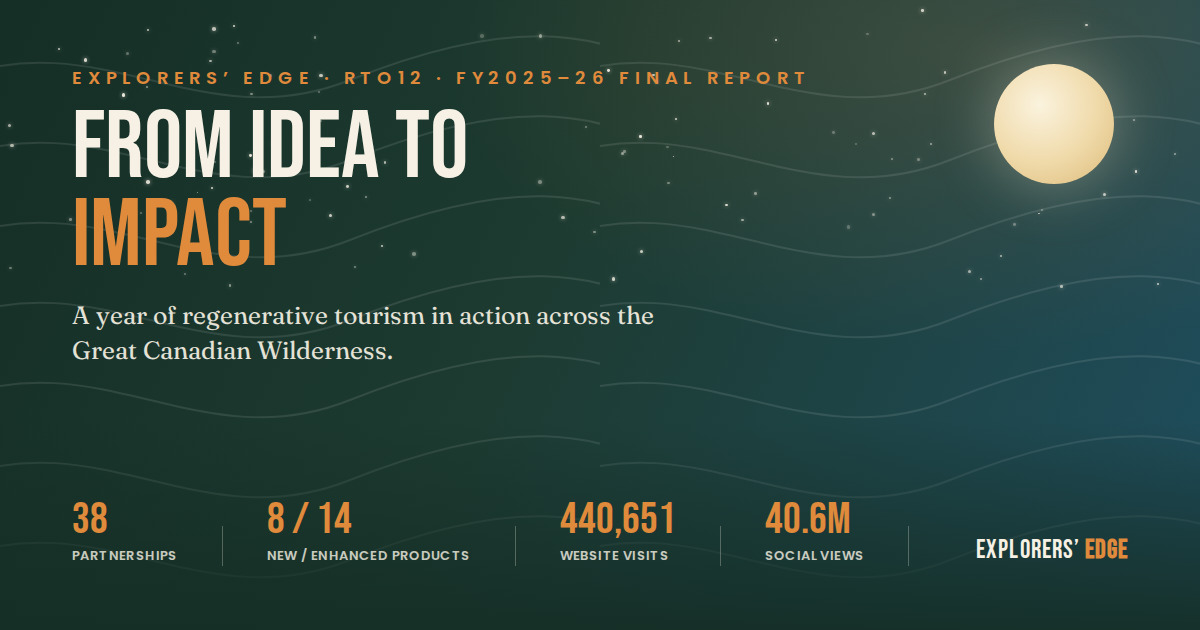
| Consumer website traffic | 440,651 visits |
| Facebook views and link clicks | 40.6 million views / 160,824 clicks |
| Instagram reach and link clicks | 1.87 million reach / 21,778 clicks |
| Investment attraction landing page views | 680 |
| Research products delivered to partners | 11 |
Pillar Highlights
Product Development
Explorers’ Edge delivered eight in-person Co-Creation Labs and produced at least eight new experiential products, along with 14 enhanced or existing products.
Dark-sky tourism pilots in Almaguin Highlands, South River and Burk’s Falls sold out both nights, drawing approximately 160 participants and validating a scalable, repeatable model for rural astrotourism.
Niche-sector work also advanced in angling, motorcycle touring and cycling, with three draft touring packages developed in each stream.
Two initiatives – a library lending-pass program and an overseas luxury-marketing test – were assessed but not activated due to limited partner capacity and elevated risk. This reflected a deliberate choice to avoid launching concepts without sufficient support.
Investment Attraction
A new investment attraction landing page, supported by stronger LinkedIn, newsletter and website storytelling, generated increased interest and direct outreach from investors and business developers, including inquiries connected to Muskoka Nordik Spa, The June Motel and others.
Explorers’ Edge advanced 11 research products, including four Business Confidence Index surveys, and supported or monitored 24 community tourism development plans.
Transportation emerged as a central investment theme. A new FlixBus stop and seasonal route were secured, while readiness work continued on the Northlander passenger rail service, Parry Sound cruise development and Air Canada access through Muskoka Airport.
Together, these efforts positioned transportation as a catalyst for visitor dispersion, improved access and future package revenue.
Workforce Development
High-school tourism programming reached approximately 120 students in Huntsville, Bracebridge and Gravenhurst through Specialist High Skills Major, Reach Ahead and careers-in-tourism sessions.
Across 11 RTO-sponsored workforce and capacity-building initiatives, 388 stakeholder participation instances were recorded.
Post-training surveys showed:
- 72% of operators reported improvements to their business capacity.
- 68% of operators reported improvements to customer service.
The Big Applause Awards were repositioned to recognize shoulder-season workers, while Diva Dialogues advanced inclusive-growth training for 40 participants.
Early workforce-housing conversations in Almaguin Highlands also began connecting labour attraction with broader community capacity.
Marketing
Marketing continued its shift from awareness to conversion.
Seven market-ready travel packages were live on the RTO website by year-end, and the first overnight package, A Muskoka Maple Adventure, launched in March 2026.
The consumer website, TheGreatCanadianWilderness.com, recorded:
- 440,651 visits
- 46,622 referral clicks to partner websites
The industry website recorded 158,071 views.
Facebook generated more than 40.6 million views and 167,483 interactions, while Instagram delivered 1.87 million in reach and 345,061 views. Both platforms outperformed industry benchmark engagement rates.
Strong earned-media coverage, including appearances through CHCH Morning Live and coverage in The Globe and Mail, reinforced shoulder-season visibility.
Partnership Program
The Partnership Program remained one of the organization’s most powerful regional tools.
During the year, the program:
- Facilitated 85 inquiries and meetings
- Advanced 42 draft proposals
- Finalized 38 formal partnerships
These partnerships spanned product development, wayfinding, cultural tourism, Indigenous tourism, visitor intelligence and transportation-linked visitor dispersion.
Notable results included:
- Municipality of Magnetawan wayfinding and A.J. Casson interpretive signage project
- Muskoka Marathon: 2,048 finishers and approximately $1.8 million in estimated visitor spending
- Muskoka Arts & Crafts: $50,195 in ticket revenue and more than 8,000 visitors
- Oktoberfest Muskoka: 34 million media impressions, representing a 126% year-over-year increase
The hiring of a dedicated Partnership Manager strengthened outreach and established the foundation for a more strategic, outcome-based program in 2026–27.
Key Challenges
- Staffing transitions and internal capacity pressures required significant management attention and affected the timing of package-activation work.
- Industry readiness varied across communities, with some operators requiring additional support before moving into bookable, conversion-ready experiences.
- Transportation access remains a structural gap, with rail, coach, air, shuttle and last-mile solutions not yet fully aligned with tourism product development.
- The Regenerative Travel Agency model is still emerging and requires continued refinement of pricing, packaging, operator participation and sales processes.
- Partnership demand continues to exceed available funding, requiring careful prioritization across a large rural area.
Next Steps and Recommendations
Explorers’ Edge will move its strongest Co-Creation Lab and Partnership Program concepts into market-ready, bookable experiences.
The organization will continue developing the Regenerative Travel Agency’s sales pathway, including:
- Package landing pages
- Online purchasing functionality
- Lead capture
- Operator onboarding
- Pricing and packaging processes
Transportation work will advance through potential FlixBus route expansion and continued engagement with Ontario Northland, Parry Sound cruise partners, Muskoka Airport and Air Canada.
The Indigenous Youth Tourism Entrepreneurship Strategy will progress toward a June 2026 Youth Summit, while sustainability, accessibility and workforce-development programming will continue to expand.
Explorers’ Edge recommends:
- Continued ministry support for regenerative, cross-pillar tourism models
- Recognition of Co-Creation Labs as a rural product-development best practice
- Flexible funding for transportation pilots
- Relationship-based funding models that respect Indigenous- and community-led timelines
Conclusion
The 2025–26 year demonstrated the practical value of regenerative tourism as an operating model—not simply as a strategic concept.
Explorers’ Edge delivered meaningful activity across a large and diverse rural area, supporting operators and communities at different stages of readiness.
The organization also continued building the systems required to connect:
- Product development
- Workforce capacity
- Transportation access
- Marketing
- Partnerships
- Investment readiness
Challenges remain around organizational capacity, transportation alignment and the time required to move emerging experiences into market-ready products.
However, the year established a stronger foundation for long-term growth—positioning Explorers’ Edge to move from awareness to conversion, from pilot projects to bookable experiences, and from individual initiatives to coordinated impact.